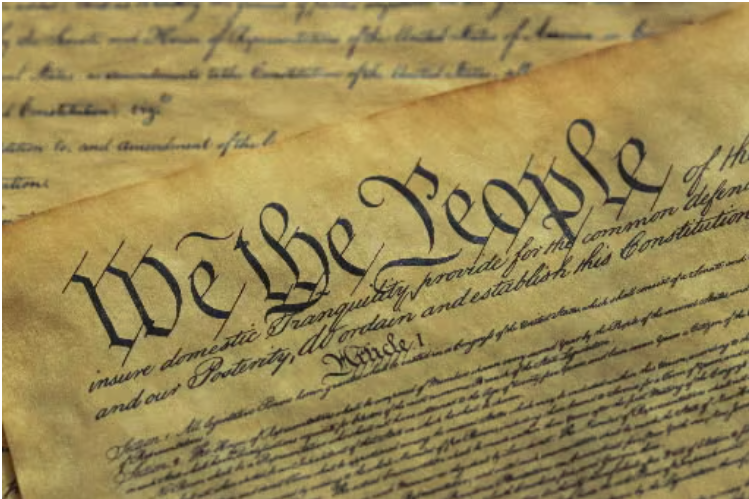
“We the people…”
Those are possibly the most important first words of any document written as a governing ideal. And those words are the reason I feel compelled to write this post. As a former “government worker,” I wanted to share a few first-person thoughts about the role of government (versus the role of a business) in today’s chaotic, corporate-dominated world.
Let me first state the obvious premise: Our government’s role is about its customers —
WE, the PEOPLE of the United States.
I worked in advertising for many years. Everything I worked on was based on tailoring the message to a specific target audience.
Projects began with the creative team developing a complete understanding of our client’s USP (Unique Selling Proposition — what makes their product or service better/more desirable/more beneficial than the competition’s). Crucially, the task required us to take an even deeper dive into the specific demographics, needs, and desires of the potential customer.
Businesses have the luxury — and it is a luxury — of targeting customers according to the product, service, function, class, values, etc., that most closely match whatever it is they are trying to sell. In simple terms, demographic targeting is driven by the profit motive, which is central to a business’s ability to stay in business. However, profit, in this sense, has no place when considering what the government is asked to provide.
All government roles (from clerk typists, environmental engineers, epidemiologists, and tax collectors, to congress members, judges, and even presidents) have the responsibility to conserve, protect, and use the wide range of our nation’s resources to benefit “we the people.” (This is especially true of the federal government.)
More fundamentally, our government’s role is to serve ALL people, regardless of social strata, class, race, creed, age, or level of economic output OR need.
Governments don’t get to target their customer because that customer is everybody.
The government must:
-
- Provide equal and equitable services (and open access to those services) for customers in every income bracket. (NOTE: I believe that most people — certainly the vast majority of people — want to get along. I may be wrong, but I also believe that most people are willing to compromise to safeguard the most important issues that impact their lives. Whether those services involve public health and safety, infrastructure, revenue collection (taxes), or justice, a government of the people, by the people, for the people is the central tenet that defined America’s founding.)
- Provide economic and physical stability that protects and promotes the freedoms of all residents, regardless of financial connectedness or lack of connectedness.
- Provide services that are blind to its customers’ social standing, whether that place was:
-
-
- chosen (people who are “well to do,” the top 1%)
- a preferred living situation (people who work, and can choose where and how they live, ~top 10%)
- doing the best one can within one’s means (people who choose to live with — and accept living with debt — old-timers called it living paycheck-to-paycheck — this is the place the vast majority of Americans find themselves, the large middle class)
- those forced to struggle without means (people who may work, but have unstable housing or are homeless for any myriad of reasons)
- those who cannot fend for themselves (truly the most vulnerable among us)
-
Those are the segments of society that our government must serve — and very much not in that order, although you’d never guess it listening to a typical republican. After all, isn’t the government’s top priority to safeguard the conditions that enable folks from c, d, and e to aspire to and reach levels b and a?
A government of the people, for the people,
by the people, is the central tenet of our nation.
Government casts a much wider net and is required to serve an infinitely broader demographic than any business.
Successful businesses typically target those willing (and able) to pay the most for whatever they’re selling, to achieve the best possible return. That is exactly the luxury the government does not have!
In addition, it’s essential to remember that government workers typically deal with a LOT of people and situations that most Americans never take a moment to consider. (I know this from personal experience, where it was my responsibility to respond to complaints directed to — and at — a large county health department. People conveniently forget that health department workers also breathe the same air, drink the same water, eat in the same restaurants, live in the same aging homes, congregate in the same churches, have the same kind of concerns, etc., as everyone else in the community.)
On the other hand, government legislators are elected to understand, evaluate, consider, and communicate even more of society’s issues, needs, problems, and priorities than the average citizen. It could be argued that’s why many elected representatives have been accused of using public office to cash in, not to serve the people — but that’s an idea for a different post. [Connected thought, look up the meaning of “gilded,” then take a look at what’s been done to the Oval Office – talk about using government to feather one’s own nest! Looks disgusting in a late 19th-century robber-barron kind of fashion to me.)
Governments aren’t elected to rule over us. Governments are in place to play a role that benefits all of us.
That’s why I was so offended by the Musk/DOGE insinuation that government workers were examples of the waste, fraud, and abuse they were supposedly tasked to expose and purge. Government workers are a core component of our nation’s needed middle class.
I’m not saying there were no problems before this administration. I am saying there are better, much more effective ways of fixing those problems than taking a chainsaw to them. Our economy is witnessing the law of unintended consequences because people who don’t understand the role of government think they know how government should be run. Everything is a transaction in their world, it seems, especially if the transaction enriches them.
Nobody I know was getting rich working for the public health department. (Some were understandably better off than others, but that was typically due to their education, prior experience, and responsibilities. That was acceptable and expected within a broad middle class that the department’s staff represented. There weren’t any billionaires, that’s for sure.)
The document starting with “We the people” (hint: it’s the preamble to the US Constitution) outlines the principles for a working government and sets the direction for the entire charter that follows. It is not a source of power or individual rights. It makes the universal claim that introduces the need for the articles and amendments to the Constitution that follow.
“We the People” is the demographic our government is required to serve. It is our government’s central positioning statement. Most emphatically, it is why government cannot and should not be run like a business. Because the business of government is to serve, not turn a profit.
####